Frame the modeling question
Define what the model must explain or predict before choosing components, equations, or a level of fidelity.
Forthcoming · Advanced engineering reference
From Physical Principles to Executable Simulation Models
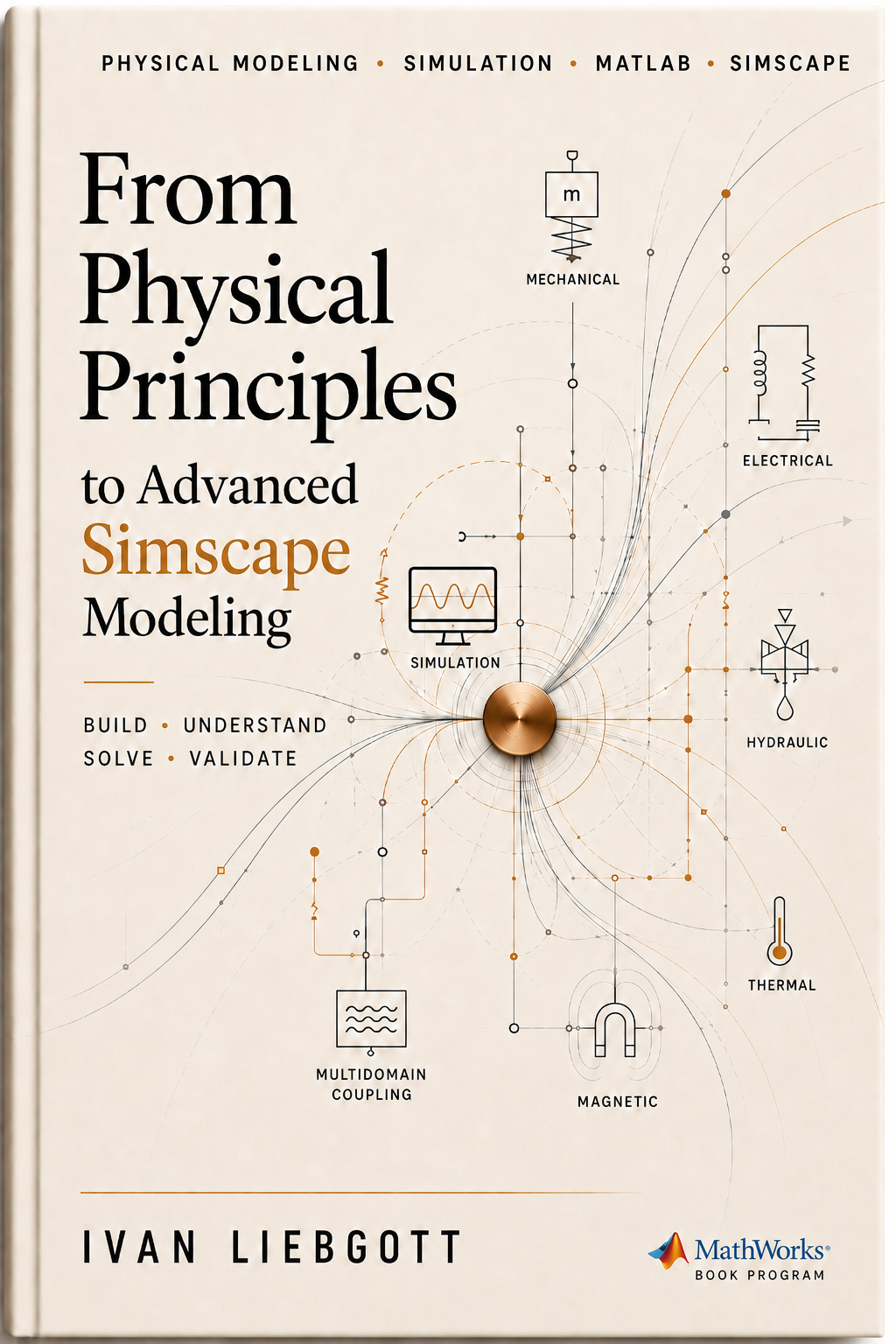
Physical modeling and simulation lie at the intersection of several forms of knowledge. This book connects the fundamental principles of physics, energy as a common language across physical domains, engineering knowledge, software practice, and the mathematical and numerical analysis required to understand how models are formulated and solved.
A coherent approach to physical modeling.Helping modelers build, understand, solve, and validate with confidence.
THE FOUNDATION OF THE BOOK
The book is built at the point where these fields meet. It unifies them into a coherent way to formulate, implement, solve, interpret, and validate physical models with Simscape.
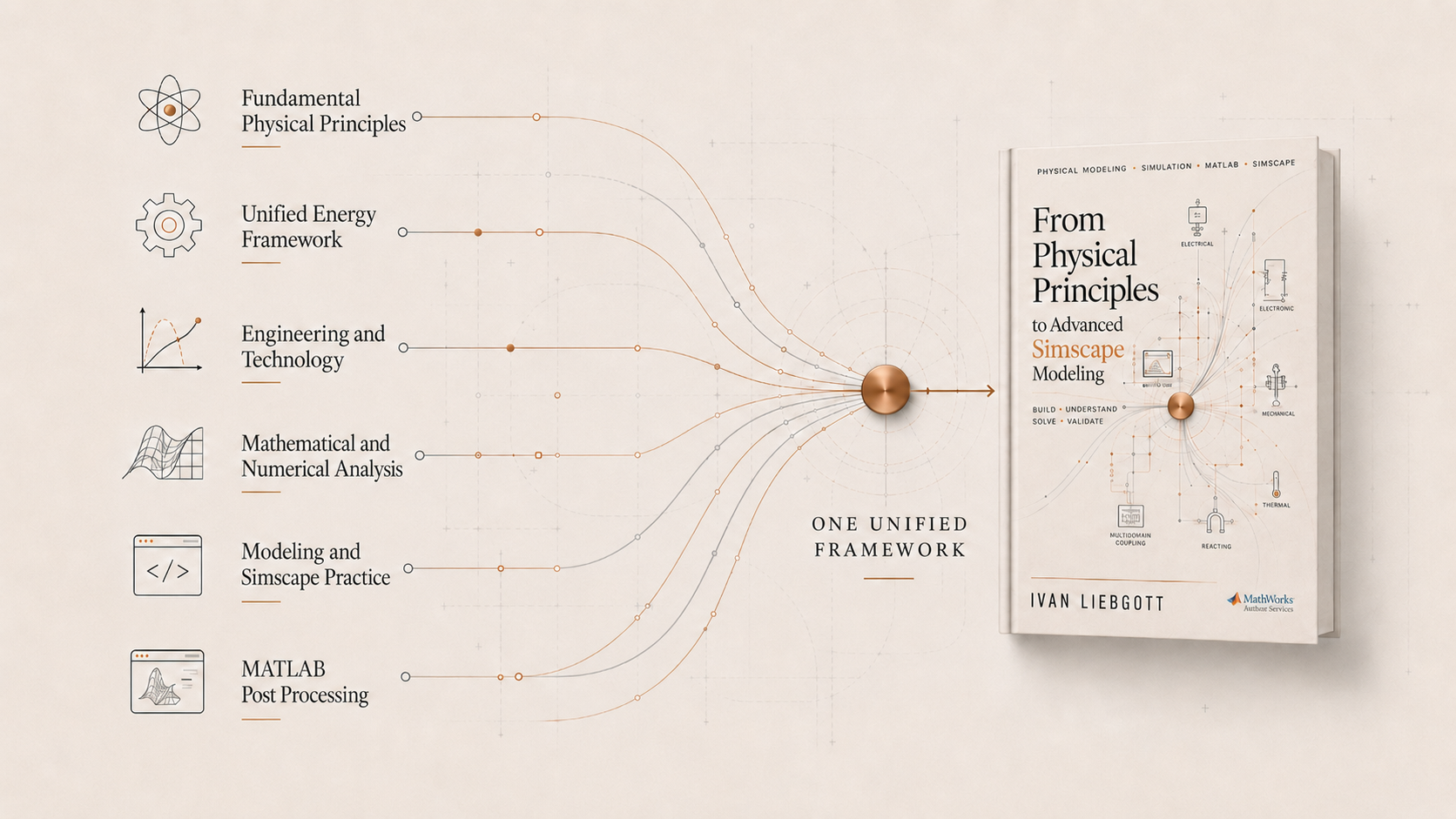
Fundamental physics provides the laws. Energy provides the common language. Engineering gives the model technological meaning. Mathematics reveals its structure. Simscape turns it into an executable model.
01 · DEEPENING THE MODELING PRACTICE
Simscape makes it possible to explore physical systems directly and intuitively. This book builds on that accessibility, helping readers make their modeling choices more explicit, connect physical behavior with mathematical structure, and develop greater confidence in the way they build, analyze, and validate their models.
What must the model actually predict?
Which physical effects matter—and which can be neglected?
Which variables become states, and which remain constrained?
Why does a seemingly valid model become numerically difficult?
How can its results be judged physically meaningful?
A CENTRAL PRINCIPLE
“Physical modeling is largely the art of managing assumptions.”
Good models do not simply reproduce a system. They make deliberate, physically justified choices about what the system should become.
02 · CORE SKILLS
The chapters develop six complementary capabilities. Together, they form a transferable modeling practice that applies across physical domains, model sizes, and levels of numerical difficulty.
Define what the model must explain or predict before choosing components, equations, or a level of fidelity.
State boundaries, reference choices, relevant phenomena, parameters, and operating regimes in a clear Model Datasheet.
Interpret Across and Through variables, component orientation, bidirectional interactions, and conservation relations as physical structure.
Recognize storage, dissipation, transfer, and conversion as a common language across electrical, mechanical, thermal, hydraulic, and magnetic systems.
Connect states and constraints to DAE formulation, consistent initialization, Jacobians, tolerances, and solver behavior.
Challenge results through signs, units, limiting cases, energy balances, parameter sensitivity, and physical expectations.
03 · LEARNING OBJECTIVES
The book is designed to change what a reader notices when looking at a Simscape model. Behind the components and connections lie a modeling objective, a set of assumptions, an energetic structure, and a mathematical problem. Learning to make those layers visible is the real progression developed across the book.
The same physical system can lead to several valid models. A model intended to predict motion is not necessarily the model required to estimate energy consumption, evaluate thermal behavior, design a controller, or investigate failure. The book teaches readers to define that purpose first, then choose the boundary, level of detail, variables, and operating regimes that follow from it.
Assumptions therefore become part of the model’s architecture. Neglecting inertia, compressibility, heat transfer, leakage, saturation, friction, or parasitic effects changes both the equations and the domain in which the results can be trusted. The aim is not maximum detail. It is the right physical content, made explicit and defensible.
Connections in Simscape are not signal lines. They impose compatibility and conservation relations. Components are not input–output operators; each contributes constitutive equations to a network whose behavior emerges from their simultaneous satisfaction. Across and Through variables provide the language for reading that structure across domains.
This changes how a model is interpreted. Orientation acquires physical meaning. Through variables are conserved at connections. Interaction is intrinsically bidirectional, and causality is determined through equation assembly rather than by the direction in which the diagram is drawn. The graphical model becomes readable as physics.
Energy storage, dissipation, conversion, sources, and constraints create a common structure across electrical, mechanical, thermal, hydraulic, magnetic, and coupled systems. From that structure come the independent states, algebraic constraints, constitutive laws, and conservation equations assembled into a differential-algebraic equation system.
Initialization can then be understood as a consistency problem; time integration as the repeated solution of discretized residual equations; and nonlinear iteration as a correction process guided by the Jacobian. Stiffness, singularity, solver tolerances, and convergence cease to be remote numerical details: they become consequences that can often be traced back to physical choices in the model.
A plausible curve is not sufficient evidence that a model is correct. The book develops validation as a layered engineering activity: checking assumptions, topology, units, signs, references, parameter ranges, energy behavior, initial conditions, steady states, limiting cases, and finally agreement with experiments or reference solutions.
Readers learn to perturb models deliberately—remove dissipation, increase leakage, approach an ideal constraint, activate a hard stop, change an initial condition—and explain what changes. Unexpected behavior becomes diagnostic evidence. The central skill is learning to separate a physical effect from a modeling inconsistency or a numerical difficulty.
A NEW SET OF QUESTIONS
What question is this model intended to answer?
Which assumptions define its domain of validity?
Where is energy stored, transferred, converted, or dissipated?
How many independent dynamic states should the system contain?
Are the initial conditions mutually consistent?
Is an unexpected result physical, structural, or numerical?
By making these layers explicit, the apparent simplicity of Simscape becomes genuinely usable. The reader is prepared not merely to run models, but to explain why they are structured as they are, diagnose why they may fail, and judge when their results deserve confidence.
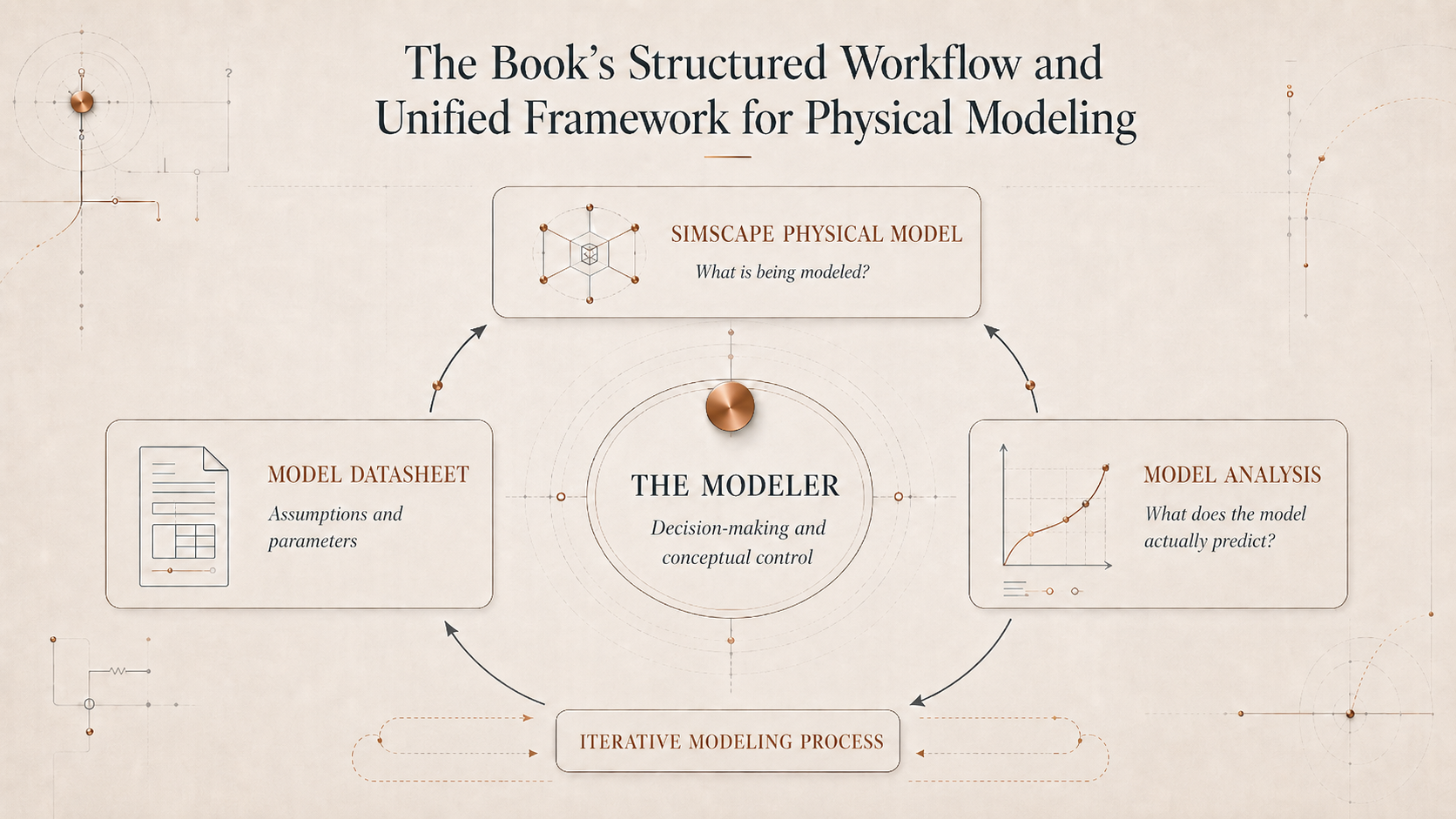
The book accompanies the reader until these questions become a natural part of the modeling process.04 · A UNIFIED MODELING FRAMEWORK
05 · FROM PHYSICS TO COMPUTATION
The book follows the complete path from observed behavior to a numerical result that can be interpreted and defended.
06 · SCOPE
The objective is to develop a transferable way of thinking across domains and levels of mathematical difficulty.
Foundations of physical modeling
Modeling methodology
Mechanical systems
Electrical systems
Thermal systems
Hydraulic systems
Magnetic systems
Multiphysics coupling
DAE formulation and numerical solvers
Initialization and numerical robustness
Model analysis and validation
Control and linearization
Advanced insights and common pitfalls
WHO THE BOOK IS FOR
This book is written for practicing and R&D engineers, advanced and doctoral students, university instructors and academics, and researchers working with physical modeling and simulation.
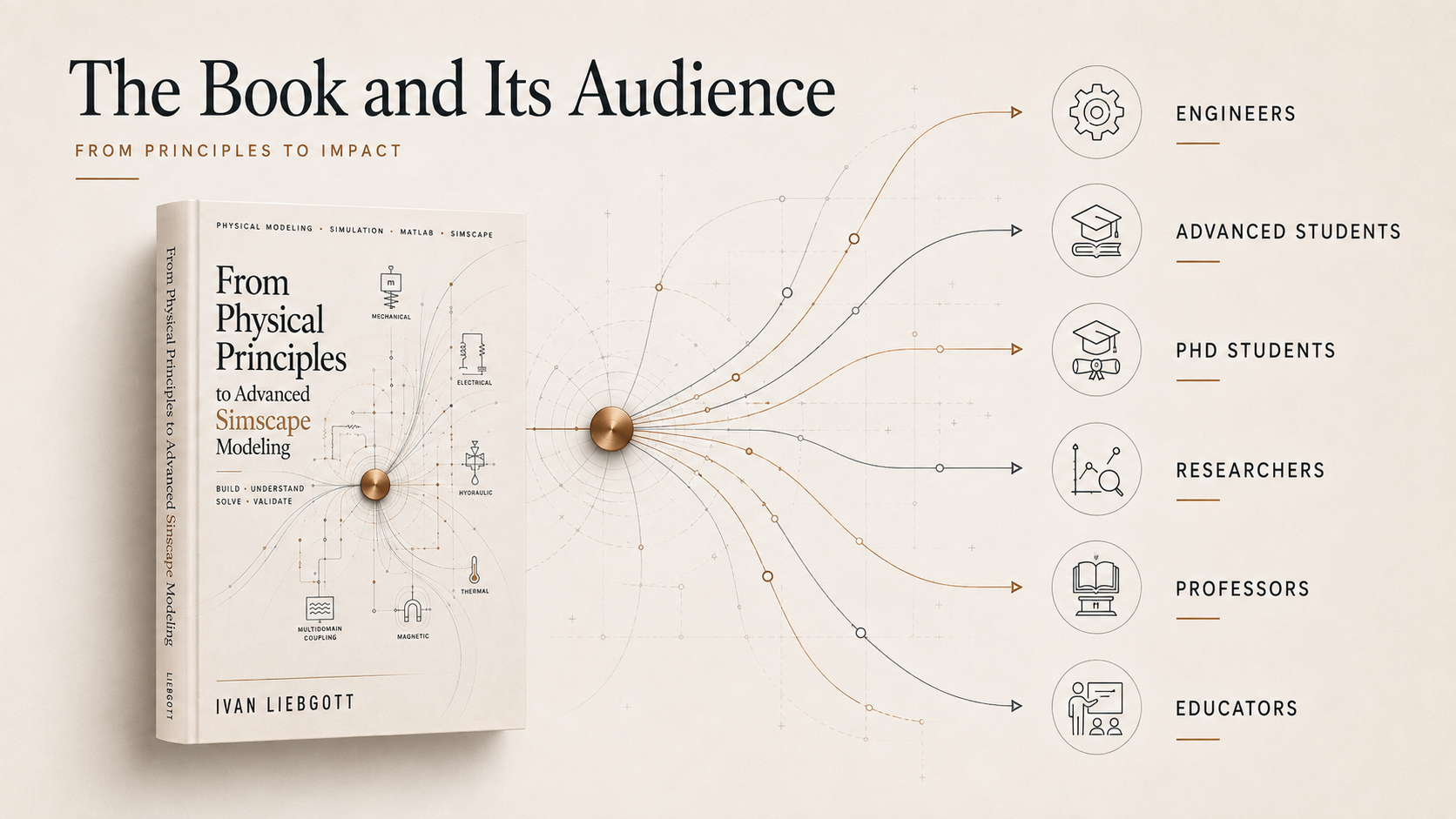
It assumes a foundation in engineering, applied science, or numerical simulation. The aim is to move from assembling components to understanding assumptions, physical networks, DAE structure, solvers, and validation.
07 · CONTENT PREVIEW
Equations, model diagrams, datasheets, plots, and interpretation are developed together. Selected sample pages and technical spreads will be published as the final edition approaches release.
Engineering questions, boundaries, assumptions, parameters, references, and expected outputs are made explicit before implementation.
Mathematical formulation remains connected to orientation, conserving connections, energy structure, and physical interpretation.
Initialization, solver behavior, limiting cases, energy balances, and failure modes are treated as part of modeling.
08 · COMPANION RESOURCES
Downloadable material will support reconstruction, analysis, and extension of the models—not simply reproduce screenshots from the book.
TECHNICAL REVIEW IN PROGRESS
The manuscript is currently being prepared for technical review by experienced Simscape professionals. Reviewer details and any formal participation will be added only when confirmed.
09 · CONCLUSION
By the end of the book, a Simscape model is no longer only an assembly of components. It becomes the visible expression of physical hypotheses, conservation laws, constitutive relations, states, constraints, and numerical choices.
The reader learns to move naturally from the physical system to the Model Datasheet, from the datasheet to the network, and from the network to the mathematical and numerical structure assembled behind it.
Model analysis becomes part of the modeling process itself. Assumptions can be challenged, unexpected behavior investigated, and results defended with a clear view of what the model includes, what it neglects, and where its conclusions remain valid.
PUBLICATION IN PREPARATION
Publication details, sample pages, and the release-notification list will be added as the final edition approaches completion.
Follow the book’s progress